This is a response to a fellow car forum member reproducing an "article" from a website called thedailymash satirising Public Sector workers defense of their penson rights. The "article" hit all the usual cheap right wing targets - strikers who act like pigs, teachers who can't spell, all the usual Tory bullshit:
God knows what sort of society "thedailymash" wants. Doctors are talking about strike action now. Another triumph for the ConDems.
Some people need a lesson in what the Trades Unions have done - and are doing - for the working man and woman. The Tories under Thatcher, Labour under Blair, and now the ConDems under Cameron are ruining this country. Our industrial base is disappearing (only yesterday the train manufacturer Bombardier announced 1400 redundancies), our politicians are in thrall to Murdoch and his murky empire, and the Bankers are still paying themselves huge bonuses. The public sector Unions seem to be the only ones who have a grip on reality. Why shouldn't they defend their members interests? At last (and at least) someone is taking a stand.
I wonder when the working people who support the coalition will wake up. When their nearest hospital is privatised? When families by the thousand are thrown out of homes they can no longer afford? When their local schools all have to be sponsored by car dealers? When this country is sucked dry by Osborne and his banker pals and unemployment hits three and a half million again? Or higher?
Who is going to look after your interests then? I suggest that all workers who don't already belong join a Trade Union, and that those who are members get active and open their eyes to what is really going on here.
How many Charity shops do you want in your High Street? How expensive do you want your weekly shopping basket to be? How much are you prepared to pay for a litre of fuel?
Never mind, eh? Roll over and laugh while they screw you!
Wednesday, July 06, 2011


Sunday, July 03, 2011
The review that caused the fuss . . . .
Here's the review I wrote on Amazon about Edmund de Waal's book on his family history. Certainly caused a fuss. Follow the link at the end if you want to see the posts it engendered on Amazon.
The Hare with Amber Eyes: A Hidden Inheritance (Hardcover)
I really wanted to like this book and, as far as literary craftsmanship is concerned, I do. It is beautifully written. But I can't help feeling that there is something important missing. We read about the fabulous wealth (and it was really fabulous) of the Author's forebears (the Ephrussis) going back five generations. These were men - and a few women - who commissioned works of Art from such as Renoir and Manet; who lived in huge palaces in the centre of Paris or Vienna; who owned huge estates in the Czech countryside and homes in many different cities; and who assembled their massive wealth, not through invention or production, but through banking and brokerage in foodstuffs. In living as the Author describes none of them, I am certain, meant any harm to anyone. They saw themselves, surely, as model employers, as philanthropists. They floated above normal Viennese (and Parisian) society; they were hardly affected by the First World War; the slump and depression of the early 1930s didn't affect their standard of living much; only the Nazis were able to bring down their world of privilege after the Austrian Anschluss of late 1937. And, unforgiveably, this happened because they were Jewish, as it happened to so many at the time. But the consequences for this particular very rich family were not as serious as for many of their fellow Jews, since they were able to buy their exits from Nazi Austria, albeit at the expense of almost their entire fortune, and with a huge amount of very stressful anxiety (which circumstance, the Author indicates, sadly killed his Great Grandmother). But those members of the Family who ended up in England for the duration of the Second World War lived in more comfort than many of the English, in a villa in Tunbridge Wells. Distant connections and some friends had their lives ended, tragically, in Nazi death camps, but these cultivated, educated, privileged people survived, although in very reduced circumstances.
The account of events immediately after Anschluss are very interesting. At first the local Austrian Brownshirts trashed the Ephrussi Palace in what seems, from the descriptions in the book, as much like undirected class resentment as political violence and sequestration. Only when the Germans arrived did the systematic theft of the family's treasures take place. The poor (or poorer) people of Vienna wrought a sort of violent anti-capitalist vengeance before the serious work of the German SS commenced. All this was and is deplorable, of course. But, rather like the Bankers in our present society, I wonder if the Author's forebears had any idea of the resentment that they had stoked up against themselves with their fabulous and unreal standard of living.
So I read this book with great interest and enjoyed it for the most part. But from fairly early on I had an unworthy feeling that "they had it coming". Not the anti-Jewish persecutions - which, it surely goes without saying, were utterly barbaric and inexcusable - but a reckoning with and by the poor and the dispossessed, even if their poverty and dispossession was only relative. (I sincerely hope that no-one reads this as any sort of apology for or justification of, the atrocities of the Nazis' vile regime; I have simply tried to be scrupulous in my explanation of the uneasiness I felt at the story told in this book.)
And I was left with an interesting question. Just how civilised are (were) the very rich? Of course, they have all the hallmarks of civilisation - appreciation of high Art and Culture, a code of behaviour which appears to be the epitome of politeness, often a great philanthropy, a facility with languages, a wide reading, cleanliness, reliability, and (that elusive quality) character. But - you have to accept - the very rich are very rich because they are able to make a profit from the labour and from the needs of their fellow men. At what point on the sliding scale does "a fair profit" become rank exploitation?
It is always fruitless to say "this would have been a better book if . . ." but a little more empathy from the Author for the poor and the dispossessed who formed the foundations of the society in which the Ephrussis flourished so remarkably would have been welcome.
The review and the posts it engendered.
The Hare with Amber Eyes: A Hidden Inheritance (Hardcover)
I really wanted to like this book and, as far as literary craftsmanship is concerned, I do. It is beautifully written. But I can't help feeling that there is something important missing. We read about the fabulous wealth (and it was really fabulous) of the Author's forebears (the Ephrussis) going back five generations. These were men - and a few women - who commissioned works of Art from such as Renoir and Manet; who lived in huge palaces in the centre of Paris or Vienna; who owned huge estates in the Czech countryside and homes in many different cities; and who assembled their massive wealth, not through invention or production, but through banking and brokerage in foodstuffs. In living as the Author describes none of them, I am certain, meant any harm to anyone. They saw themselves, surely, as model employers, as philanthropists. They floated above normal Viennese (and Parisian) society; they were hardly affected by the First World War; the slump and depression of the early 1930s didn't affect their standard of living much; only the Nazis were able to bring down their world of privilege after the Austrian Anschluss of late 1937. And, unforgiveably, this happened because they were Jewish, as it happened to so many at the time. But the consequences for this particular very rich family were not as serious as for many of their fellow Jews, since they were able to buy their exits from Nazi Austria, albeit at the expense of almost their entire fortune, and with a huge amount of very stressful anxiety (which circumstance, the Author indicates, sadly killed his Great Grandmother). But those members of the Family who ended up in England for the duration of the Second World War lived in more comfort than many of the English, in a villa in Tunbridge Wells. Distant connections and some friends had their lives ended, tragically, in Nazi death camps, but these cultivated, educated, privileged people survived, although in very reduced circumstances.
The account of events immediately after Anschluss are very interesting. At first the local Austrian Brownshirts trashed the Ephrussi Palace in what seems, from the descriptions in the book, as much like undirected class resentment as political violence and sequestration. Only when the Germans arrived did the systematic theft of the family's treasures take place. The poor (or poorer) people of Vienna wrought a sort of violent anti-capitalist vengeance before the serious work of the German SS commenced. All this was and is deplorable, of course. But, rather like the Bankers in our present society, I wonder if the Author's forebears had any idea of the resentment that they had stoked up against themselves with their fabulous and unreal standard of living.
So I read this book with great interest and enjoyed it for the most part. But from fairly early on I had an unworthy feeling that "they had it coming". Not the anti-Jewish persecutions - which, it surely goes without saying, were utterly barbaric and inexcusable - but a reckoning with and by the poor and the dispossessed, even if their poverty and dispossession was only relative. (I sincerely hope that no-one reads this as any sort of apology for or justification of, the atrocities of the Nazis' vile regime; I have simply tried to be scrupulous in my explanation of the uneasiness I felt at the story told in this book.)
And I was left with an interesting question. Just how civilised are (were) the very rich? Of course, they have all the hallmarks of civilisation - appreciation of high Art and Culture, a code of behaviour which appears to be the epitome of politeness, often a great philanthropy, a facility with languages, a wide reading, cleanliness, reliability, and (that elusive quality) character. But - you have to accept - the very rich are very rich because they are able to make a profit from the labour and from the needs of their fellow men. At what point on the sliding scale does "a fair profit" become rank exploitation?
It is always fruitless to say "this would have been a better book if . . ." but a little more empathy from the Author for the poor and the dispossessed who formed the foundations of the society in which the Ephrussis flourished so remarkably would have been welcome.
The review and the posts it engendered.
Thursday, February 03, 2011
Greer versus GBS
Ten days ago Germaine Greer had a go at the reputation of George Bernard Shaw in the Guardian; yesterday the post graduate student who set her going by sending her his paper on GBS. Then last night there was a bit of chatter in the paper's "Comment is Free" site. This was my contribution:
Let's have a think about some of the right-on things Germaine has forced on us over the years. Well, before "The Female Eunuch" there was the full-frontal picture she posed for in "Oz"; as I remember, quite titillating but not particularly feminist. Then there was her Latin Lover period, when she urged women to take a Latin Lover because they could keep on having sex for ages and made it a matter of pride not to ejaculate inside a woman - or even at all, as I recall her account of her very own Latin Lover. There were the aforementioned pops at Tom Paine for abandoning his Wife (er . . . no!) and at poor old repressed A E Housman who managed to write some pretty little things in his day but did have the audacity to offend Greer by fancying "lads" rather than lasses and inspiring - apparently - the whole greetings card industry. She also suggested that a degree of moral and cultural relativism is OK when thinking about Female Genital Mutilation, seeming to make the assumption that it was wrong for us to judge the traditional acts of another culture. This was denied, but her words upset a House of Commons Select Committee at the time. And that Shakespeare! He was a bit of a bludger, wasn't he? After "The Female Eunuch" she co-hosted a sort of Comdey show for TV with Kenny Everett. And a few years back she appeared as a participant in the "Big Brother" house. So that's her extra-academic career. She's a bit of an old windbag really. Funny how you never see her and Clive James together in the same room.
Let's have a think about some of the right-on things Germaine has forced on us over the years. Well, before "The Female Eunuch" there was the full-frontal picture she posed for in "Oz"; as I remember, quite titillating but not particularly feminist. Then there was her Latin Lover period, when she urged women to take a Latin Lover because they could keep on having sex for ages and made it a matter of pride not to ejaculate inside a woman - or even at all, as I recall her account of her very own Latin Lover. There were the aforementioned pops at Tom Paine for abandoning his Wife (er . . . no!) and at poor old repressed A E Housman who managed to write some pretty little things in his day but did have the audacity to offend Greer by fancying "lads" rather than lasses and inspiring - apparently - the whole greetings card industry. She also suggested that a degree of moral and cultural relativism is OK when thinking about Female Genital Mutilation, seeming to make the assumption that it was wrong for us to judge the traditional acts of another culture. This was denied, but her words upset a House of Commons Select Committee at the time. And that Shakespeare! He was a bit of a bludger, wasn't he? After "The Female Eunuch" she co-hosted a sort of Comdey show for TV with Kenny Everett. And a few years back she appeared as a participant in the "Big Brother" house. So that's her extra-academic career. She's a bit of an old windbag really. Funny how you never see her and Clive James together in the same room.
Anyway, the poor old girl wrote one goodish book back in 1970, since when she's flailed around. I like GBS. I think he'll outlast her.
Sunday, January 30, 2011
I hate Michael Gove
Michael Gove has embraced the idea of "Boot Camps" to sort out disaffected young people. There's been a lively debate on the Guardian's "Comment is Free" website, to which I just had to respond:
Just shows that the Tories haven't changed at all. Still the Nasty Party. The Thatcherite "short sharp shock" re-emerges as the Govian boot-camp. Just as prisons breed criiminals so boot-camps will breed either thugs or suicides. I was amused by the comment that Gove probably gets a semi at the mention of "boot camp".
Seems to me that the current crop of Tories put problems into two categories. First come "the problems that affect me". These need careful analysis and complex schemes of action. "How do I get to be filthy rich?" "How do I keep the bloody Oiks off my land?" "How do I find a little man who will do all the jobs I can't be arsed to do myself, preferably for virtually no money?" And "Where shall I keep all the money I hope to make?" (This last question is perhaps the most important.)
Then there are "the problems which affect society at large". These are easy to solve; they require no depth of analysis or thinking; a short phrase will get us off the hook here! So the problem of inequality in society? "Tell the proles we're all in this together". Economic woes? Huge budget deficit? "Throw another million out of work to drive wage costs down." Disaffected and disruptive youth? "Boot Camp".
But then the hacks in the various Ministries get hold of the soundbite and may even try to act on it. God help us if they take Gove seriously.
Kenneth Baker, Tory Education Minister in the late eighties and architect of the National Curriculum, said in a Guardian interview in 2008 "I think anybody doing educational change should begin slowly." Would he please talk to Gove?
Just shows that the Tories haven't changed at all. Still the Nasty Party. The Thatcherite "short sharp shock" re-emerges as the Govian boot-camp. Just as prisons breed criiminals so boot-camps will breed either thugs or suicides. I was amused by the comment that Gove probably gets a semi at the mention of "boot camp".
Seems to me that the current crop of Tories put problems into two categories. First come "the problems that affect me". These need careful analysis and complex schemes of action. "How do I get to be filthy rich?" "How do I keep the bloody Oiks off my land?" "How do I find a little man who will do all the jobs I can't be arsed to do myself, preferably for virtually no money?" And "Where shall I keep all the money I hope to make?" (This last question is perhaps the most important.)
Then there are "the problems which affect society at large". These are easy to solve; they require no depth of analysis or thinking; a short phrase will get us off the hook here! So the problem of inequality in society? "Tell the proles we're all in this together". Economic woes? Huge budget deficit? "Throw another million out of work to drive wage costs down." Disaffected and disruptive youth? "Boot Camp".
But then the hacks in the various Ministries get hold of the soundbite and may even try to act on it. God help us if they take Gove seriously.
Kenneth Baker, Tory Education Minister in the late eighties and architect of the National Curriculum, said in a Guardian interview in 2008 "I think anybody doing educational change should begin slowly." Would he please talk to Gove?
Saturday, December 11, 2010
Charles and Camilla
After the student protest in London on Thursday over the increase in tuition fees and the axing of the Education Maintenance Allowance for poorer students, and the attack on Charley Saxe Coburg Gotha's Roller, I loved this comment from "softMick" on The Guardian website today:
"Irony could not have wished for a more timely coincidence, as young people out in force to show their revulsion at the raising of tuition fees and abolition of EMA by a government headed by very rich ex-public schoolboy Cameron and his side-kick comfortably rich ex-public schoolboy boy Clegg, subsequently barring access to higher education for kids from low income backgrounds, find themselves confronted by two royal parasites shmoozing along in the old Rolls, probably wearing clothes and jewellery that would cover a poor student's tuition fees for an entire degree course, with all expenses thrown in. The sheer obscenity of the tableau will be lost on the better offs, including the royals, and completely ignored by the media intent upon gaining knighthoods for their execs and toeing the government line. But it sickened me to the core, and makes me feel ashamed of my country and my government."
 For your enjoyment, here's the pic again.
"Irony could not have wished for a more timely coincidence, as young people out in force to show their revulsion at the raising of tuition fees and abolition of EMA by a government headed by very rich ex-public schoolboy Cameron and his side-kick comfortably rich ex-public schoolboy boy Clegg, subsequently barring access to higher education for kids from low income backgrounds, find themselves confronted by two royal parasites shmoozing along in the old Rolls, probably wearing clothes and jewellery that would cover a poor student's tuition fees for an entire degree course, with all expenses thrown in. The sheer obscenity of the tableau will be lost on the better offs, including the royals, and completely ignored by the media intent upon gaining knighthoods for their execs and toeing the government line. But it sickened me to the core, and makes me feel ashamed of my country and my government."

Thursday, November 25, 2010
Schools to change . . . . . again.
So Michael Gove wants to revolutionise English schools. Yet again an ignorant politiian sticks his oar in.
I gave up secondary teaching ten years ago. One of the reasons I did so was the constant meddling in our education system by politicians of all parties.
Once upon a time (in the 1960s) Governments commissioned reports before making changes. We had the Plowden report for Primary Schools and the Newsom report ("Half Our Future") for Secondaries. Then everybody sat around and debated them for a while, and finally changes were made. By and large this worked, and we could do a lot worse than go back and read those huge reports again.
Now, a politician gets appointed to the Education Ministry (whatever it's called this week!) and immediately starts making changes. Why? Because he or she needs to Make Their Mark before they're moved on to another post. Result: schools haven't finished implementing the last lot of changes before the next lot are on them. You couldn't run a business that way. Oh, hang on . . . . the Railways. Same management model, and look at the mess they're in.
Also Education Ministers seem to be prepared to listen to whatever charlatan shouts the loudest that schools are getting it all wrong. That started with the awful Chris Woodhead under Thatcher (he was a comparative failure as a teacher, and shagged one of his female pupils - what a star!) and the process seems to accelerate with each new Government. Blair and co seemed to think that Reg Vardy, the evangelical secondhand car dealer, knew more about schools than anyone who'd ever worked in one!
I despaired when I gave up teaching, I despair more with each passing year and each new education Minister. I want to rewrite the old Floyd song "Brick In The Wall": "Minister: leave them Schools alone!"
 Here's Steve Bell's take on it from this morning's Guardian.
I gave up secondary teaching ten years ago. One of the reasons I did so was the constant meddling in our education system by politicians of all parties.
Once upon a time (in the 1960s) Governments commissioned reports before making changes. We had the Plowden report for Primary Schools and the Newsom report ("Half Our Future") for Secondaries. Then everybody sat around and debated them for a while, and finally changes were made. By and large this worked, and we could do a lot worse than go back and read those huge reports again.
Now, a politician gets appointed to the Education Ministry (whatever it's called this week!) and immediately starts making changes. Why? Because he or she needs to Make Their Mark before they're moved on to another post. Result: schools haven't finished implementing the last lot of changes before the next lot are on them. You couldn't run a business that way. Oh, hang on . . . . the Railways. Same management model, and look at the mess they're in.
Also Education Ministers seem to be prepared to listen to whatever charlatan shouts the loudest that schools are getting it all wrong. That started with the awful Chris Woodhead under Thatcher (he was a comparative failure as a teacher, and shagged one of his female pupils - what a star!) and the process seems to accelerate with each new Government. Blair and co seemed to think that Reg Vardy, the evangelical secondhand car dealer, knew more about schools than anyone who'd ever worked in one!
I despaired when I gave up teaching, I despair more with each passing year and each new education Minister. I want to rewrite the old Floyd song "Brick In The Wall": "Minister: leave them Schools alone!"

Sunday, October 10, 2010
And then?
I've reached the point where the function of Art changed, and it changed because of two technologies: photography and printing. A photographer, even in the mid-19th Century, could record an accurate image in a fracton of the time it would take an artist to do the job less accurately. Using the new print technologies the image - or any image - could be reproduced as amny times as required, and very cheaply. Of course these are both monochromatic technologies at this point, but the writing's on the wall for painting. Just as Art came to terms with how things really look, just as the skills of the painter reached a zenith of maturalism, so those skills - as far as strict reportage is concerned - were becoming redundant.
What I'd like to carry forward is the idea that a painting has different meanings to different people right from the beginning, even before it is completed in some respects. The Artist will have a view: s/he may be obsessed with the conception and execution of the artwork as a pure work of art; s/he may have a mercenary attitude, concerned to please the commissoning patron; whatever, s/he will be concerned about achieving the desired outcome, either in artistic terms, or in terms of fulfilling the commission, or (most likely) both. The patron will have a view. How prescriptive was the commission? How well is the artist fulfilling the brief? Is it value for money? Will it enhance the patron's prestige? The casual viewer - perhaps in a saleroom or a gallery, will have a view too. What is it? Do I like it? Is it well executed? Is it any good? Does it move me?
All this is not unimportant. Consensus is harder to reach with so many different viewpoints. To take a simple example, here are some of the comments I've heard about J M W Turner's work:
* he couldn't paint people at all accurately
* he is the forerunner of the Impressionists
* he is better than the Impressionists
* his eyesight was wonky
* he is the greatest British artist of all time
* he was a hack, only in it for the money
And so on. Obviously these views are not all mutually exclusive; some people like one part of Turner's opus, some another. But there is no complete consensus, despite the historical perspective we have. Generally, what there is is a canon of work regarded as being worth looking at. And that applies to all Art up to, say, the 1900s. And then, and then . . .
What I'd like to carry forward is the idea that a painting has different meanings to different people right from the beginning, even before it is completed in some respects. The Artist will have a view: s/he may be obsessed with the conception and execution of the artwork as a pure work of art; s/he may have a mercenary attitude, concerned to please the commissoning patron; whatever, s/he will be concerned about achieving the desired outcome, either in artistic terms, or in terms of fulfilling the commission, or (most likely) both. The patron will have a view. How prescriptive was the commission? How well is the artist fulfilling the brief? Is it value for money? Will it enhance the patron's prestige? The casual viewer - perhaps in a saleroom or a gallery, will have a view too. What is it? Do I like it? Is it well executed? Is it any good? Does it move me?
All this is not unimportant. Consensus is harder to reach with so many different viewpoints. To take a simple example, here are some of the comments I've heard about J M W Turner's work:
* he couldn't paint people at all accurately
* he is the forerunner of the Impressionists
* he is better than the Impressionists
* his eyesight was wonky
* he is the greatest British artist of all time
* he was a hack, only in it for the money
And so on. Obviously these views are not all mutually exclusive; some people like one part of Turner's opus, some another. But there is no complete consensus, despite the historical perspective we have. Generally, what there is is a canon of work regarded as being worth looking at. And that applies to all Art up to, say, the 1900s. And then, and then . . .
Wednesday, September 22, 2010
Painting's different functions in the 18th and 19th Centuries

And then there's landscape; views; the picturesque. Here is one of Canaletto's views of the Thames, painted in 1747 and showing the Lord Mayor's Day Regatta. It speaks of London's importance and grandeur. It exaggerates the width of the Thames and the scale of St Pauls, but remains an astounding panorama of perhaps the most important city in the world at this time. It makes you want to be there, as does this famous painting by John Constable from 1826:

"The Cornfield" is in the long tradition of the English pastoral. We know that it subtly improved on the actual view at the time, but this doesn't matter. It's an ideal English rural view, and actually affects the way we see the countryside. It conditions us to look for the picturesque in our own countryside. It doesn't matter that we know that the lives of those working in the picture were far from idyllic; that they died young from preventable diseases; that they lived in poverty in an unequal society. It captures a moment on a hot summer's day when any of us would be happy to be in the shade and to take a drink from the same stream as the boy in the red waistcoat. It's a landscape which we can navigate in our imagination, through the gateway into the cornfield, and on to the church in the distance.
And then, from four years later there's this:

Samuel Palmer's "Magic Apple Tree" is further removed from reality, drawing on a different tradition which takes in William Blake and the Christian symbolism of the New Jerusalem. You couldn't navigate anywhere from the information in this canvas. This is a mystical picture of a strange and idealised landscape. It speaks of the spirit of place rather than topography, and as such is one of the most famous landscape pictures of the 19th Century, despite having languished in the office of the Director of the Fitzwilliam Museum in Cambridge for a number of years, kept there presumably for his private delectation. This is far removed from Thomas Gainsborough's famous double portrait and landscape of Mr and Mrs Andrews:

This has been called the ultimate 18th Century Capitalist portrait. Painted after the Andrews' wedding in 1750, it shows the happy couple in front of the landscape which they own. I detect a slightly smug air about them. Someone once said (tell me who, please?) that Mr Andrews is saying "This is my dog, this is my gun, this is my land, this is my Wife" - with the emphasis on the possessive pronoun. But there is another view which takes into account Gainsborough's recorded dislike of the "Landed Gentry" - he has painted them as being at odds with the idyllic landscape, him with his gun, she with her inappropriate dress. It's worth recording that he painted this a year after the wedding, when Mr Andrews was 23 and his Wife 17.
And now another strand which grows in importance as we enter the 19th century: animal portraiture.

This is "Whistlejacket", painted for his owner, the Marquess of Rockingham in the early 1760s, when the horse was about 12 years old. By definition racehorses have a short useful life, and rather than rely on memories of Whistlejacket's great victory over a four mile course at York in 1759 (which netted him 2,000 guineas), the noble owner commissioned Stubbs to record him. This huge canvas - almost 10 feet high - shows the animal and nothing else, a real departure in this sort of picture. While we can read this as a statement of pride in the ownership of such an animal, the sheer presence of the horse and the accuracy of the depiction, transcends such a view. This is a horse for everyone, the essence of racehorse. Unfortunately this magnificent portrait leads us on to the cloying sentimentality of the Victorian animal picture.
Tuesday, September 21, 2010
Painting's different functions in the 18th Century

So in some ways this picture is not too different in intention from the devotional works of earlier centuries, although it's unlikely that it would ever find a home in a church. Like the paintings in my last post this shows how to live a good life - or rather, in this case, what to avoid in order to live a good life. It is, for most of us in the 21st Century, a more powerful image than a picture of the Holy Family, or a saint or two, no matter how much gold-leaf the latter may display. But this is still a "morality picture" in a tradition which stretches from mediaeval church wall paintings through both Breugels, Goya, and such 20th century painters as C R W Nevinson, Paul Nash ("We Are Making A New World"), and even Picasso ("Guernica").
Another form of painting which changeded over the three hundred years between 1450 and 1750 is portraiture. Always slightly questionable as a display of wealth and egoism, the only portraits with which the mediaeval peasant would have been familiar were those of the patrons of their local church who paid the artist to insert them into a corner of the altarpiece, perhaps next to an obscure saint or martyr, possibly in the belief that the painting would predict their stature in the afterlife. But now, look at this fine portrait by Thomas Gainsborough from around 1786:

This is Mrs Richard Brinsley Sheridan. As the famous soprano Elizabeth Linley, and a lifelong friend of Gainsborough, she had eloped with Sheridan, the playwright and politician twelve years before this portrait was painted. It is a "speaking likeness" - she was instantly identifiable. But Gainsborough has taken her out of the studio in which he painted her, and given her an invented rural setting. It is an utterly romantic portrait, and the wild brush-strokes with which the Artist has built up the almost impressonistic background and the details of the costume give way to a careful and masterly rendering of Mrs Sheridan's face. It is a wonderfully tender portrait. But who was it for? Only for family and friends, not for continuous public display. This is private Art, not public. You could say it is still devotional Art, but only in so far as it expresses the devotion of her husband - and of her friend the artist. The great shame is that this painting in the Mellon Collection in the USA is not on display.
Of course some portraits become famous over time, and have been adopted into the public consciousness. But there is a distinction between the portrait for public consumption (think Queen Elizabeth, Horatio Nelson, T E Lawrence) and the portrait for private satisfaction, the "this is me, this is my Wife, this is my child" sort of likeness - of no great personal interest to anyone outside the sitter's circle. Here are those public images:

The "Armada Portrait" attributed to George Gower is absolute Elizabethan propaganda.

The 1800 portrait of Nelson by Lemuel Abbott, already a National hero five years before Trafalgar.

The Augustus John portrait of T E Lawrence from 1919; taken up by a nation desperately in need of heroes who hadn't drowned in the mud of the Ypres Salient.
In contrast here's my favourite private portrait, William Chalmers-Bethune and Family painted by David Wilkie in 1804.

As a "warts and all" depicton this can hardly be beaten. And yet such tenderness is in this family portrait; I see it as a triumphant artefact of the Enlightenment in Scotland, brilliant in its unflinching honesty. Initially its appeal must have been limited to the family and friends of the Chalmers-Bethunes. Now, we see it as a window on its period, fascinating precisely because of its humanity.
Monday, September 20, 2010
Thinking
In a 1906 edition of "Punch" there's a cartoon of an old man with an injured foot sitting in a chair. He explains to the vicar's wife how he passes the time: "Sometimes I sits and thinks, and sometimes I just sits." Thinking is like that. If you set out to have a "thinking" session the chances are you won't come up with anything, Of course, if you're trying to solve a particular problem you may well be able to concentrate and find a particular, peculiar solution. But to think - in the abstract, unfettered - you'll probably end up wondering whether you should have that coffee yet, or where that list of things to do (that you wrote yesterday) has got to.
So most times when I set out to think about what Art is (and isn't) I either end up with a couple of trite truisms before drifting off to think about something else, or I find myself thinking how much I despise Tracey Emin, or Nick Serota, or . . . . insert your own pet hate; you know what I'm getting at.
Recently I've tried to change tack and go back to basics; to work forwards from a basic, incontravertible position. What was Art for in the millenia before Fox-Talbot, the Daguereotype, and photography generally? What did the artists think they were doing? What did the patrons think they were paying for? And what do we think those Artists achieved? On the surface these are easy questions to answer. But when you try to put together what they felt then, and what we feel now, you run up against a problem. To illustrate what I mean, consider a piece of devotional Art. This is Fra Angelico's "Annunciation" from around 1440:

What's happening here? Well, the Angel of the Lord has appeared to tell the virgin Mary that she's going to bear a baby who is the son of God. Mary is struck dumb, apparently, as who wouldn't be? Apart from everything else, the Angel is in awe of her, and is bending the knee . . . to a humble carpenter's wife! Amazing. The poor people who saw this painting would never have seen anything so lifelike.
These days we are struck by the painter's astounding competence and ability given the context of the times. The painting doesn't carry the spiritual, emotional weight it did five and a half centuies ago. We admire the technical skill of the Artist; his contemporaries wouldn't think like that. They were having the story of the Annunciation made flesh in their own village church - or as near as could be. Think high definition 3D for us. Or hyper-reality. That's what they saw. And it confirmed what they were told every Sunday and feast day of their lives.
I remember going round a gallery of religious images from the 12th Century through to the beginnings of the Renaissance, in Sienna a few years ago (the Pinacoteca Nazionale). After the first two rooms it left me cold. Wall after wall of religious pictures. Nativity after nativity, miracle after miracle, saint after saint. Boring. It was utter overkill. But, of course, this was a collection from the whole of Tuscany and beyond - from little churches in tiny communities. Each church might have had just one or two images. The people who worshipped in each church might be familiar with three or four other churches in similar communities - and that would be the limit of their experience of Art, and of the accurate representation of life - of simulacra.
Here's a lesser known painting from Sienna:

So most times when I set out to think about what Art is (and isn't) I either end up with a couple of trite truisms before drifting off to think about something else, or I find myself thinking how much I despise Tracey Emin, or Nick Serota, or . . . . insert your own pet hate; you know what I'm getting at.
Recently I've tried to change tack and go back to basics; to work forwards from a basic, incontravertible position. What was Art for in the millenia before Fox-Talbot, the Daguereotype, and photography generally? What did the artists think they were doing? What did the patrons think they were paying for? And what do we think those Artists achieved? On the surface these are easy questions to answer. But when you try to put together what they felt then, and what we feel now, you run up against a problem. To illustrate what I mean, consider a piece of devotional Art. This is Fra Angelico's "Annunciation" from around 1440:

What's happening here? Well, the Angel of the Lord has appeared to tell the virgin Mary that she's going to bear a baby who is the son of God. Mary is struck dumb, apparently, as who wouldn't be? Apart from everything else, the Angel is in awe of her, and is bending the knee . . . to a humble carpenter's wife! Amazing. The poor people who saw this painting would never have seen anything so lifelike.
These days we are struck by the painter's astounding competence and ability given the context of the times. The painting doesn't carry the spiritual, emotional weight it did five and a half centuies ago. We admire the technical skill of the Artist; his contemporaries wouldn't think like that. They were having the story of the Annunciation made flesh in their own village church - or as near as could be. Think high definition 3D for us. Or hyper-reality. That's what they saw. And it confirmed what they were told every Sunday and feast day of their lives.
I remember going round a gallery of religious images from the 12th Century through to the beginnings of the Renaissance, in Sienna a few years ago (the Pinacoteca Nazionale). After the first two rooms it left me cold. Wall after wall of religious pictures. Nativity after nativity, miracle after miracle, saint after saint. Boring. It was utter overkill. But, of course, this was a collection from the whole of Tuscany and beyond - from little churches in tiny communities. Each church might have had just one or two images. The people who worshipped in each church might be familiar with three or four other churches in similar communities - and that would be the limit of their experience of Art, and of the accurate representation of life - of simulacra.
Here's a lesser known painting from Sienna:

This is The Mystic Marriage of Saint Catherine and St John the Baptist by Michelino da Besozza in about 1420, now in the Sienna Gallery I visited. We cannot understand this image now unless we see it as an elaborate allegory. We cannot understand the idea of a spiritual union between a humble but saintly virginal woman, and characters who had been dead for over a millenium, or who were local dignitaries who paid for the image. But to humble "parishioners" who saw this every week in their church - and who saw no other accurate images - it was a deep reality; in some ways a deeper reality than that of their own daily existence, since it spoke of their own imminent eternity, which was going to be so much better than their earthly life.
It's taken me more than twenty years to understand the significance of those rooms and rooms of devotional Art I saw in Sienna. The paintings still do not really move me as objects in themselves. But their significance to the men and women who saw them when the paint was fresh - well, if I can respond to any work of Art in such a sincere way, I would count it a good day. No, a great day.
So now I need to think about how a more secular, less naive society looked at its Art. I'm going to move forward 300 years and think about the 18th Century.
Sunday, August 22, 2010
Birmingham Art Gallery
I visited this gallery last Friday and was amazed at the quality of the 19th Century painting which they have. There's a fine version of Ford Madox Brown's "The Last of England", almost identical to that held by the Fitzwilliam in Cambridge:

There's what must be almost a full size water-colour study for Burne Jones' "King Cophetua and the Beggar Maid":

There's Millais's "The Blind Girl:

There's a half size copy by Ford Madox brown of his "Work", the original of which hangs in Manchester:

This is Rossetti's final version of "Beata Beatrix", left unfinished at his death in 1882:

All these and many other fine Pre-Raphaelite paintings. Birmingham's modern collection is much sparser, and the very recent stuff is mostly the usual rubbish that will probably be in a skip within 20 years (we can but hope), but there is a reconstruction of Epstein's amazing "Rock Drill" from 1913 - twelve feet high and very imposing:


There's what must be almost a full size water-colour study for Burne Jones' "King Cophetua and the Beggar Maid":

There's Millais's "The Blind Girl:

There's a half size copy by Ford Madox brown of his "Work", the original of which hangs in Manchester:

This is Rossetti's final version of "Beata Beatrix", left unfinished at his death in 1882:

All these and many other fine Pre-Raphaelite paintings. Birmingham's modern collection is much sparser, and the very recent stuff is mostly the usual rubbish that will probably be in a skip within 20 years (we can but hope), but there is a reconstruction of Epstein's amazing "Rock Drill" from 1913 - twelve feet high and very imposing:

Finally a couple of works from about the same period. First is C R W Nevinson's "Column on the March" from about 1915 - stunning, and I've never seen it before:

And from a few years later, Munnings' "Arrival at Epsom Downs for Derby Day":

Tuesday, August 17, 2010
Lifted from a Google extract document - Dr David Kelly's death
I was alerted to this web page by a post on the Guardian's "Comment Is Free" website. I tried to link it to my Facebook page, but FB would not accept it - I wonder what's going on. Is it being suppressed?
Dr David Kelly: The damning new evidence that points to a cover-up by Tony Blair’s government
By Miles Goslett and Stephen FrostLast updated at 9:24 AM on 26th June 2010
The official story of Dr David Kelly is that he took his own life in an Oxfordshire wood by overdosing on painkillers and cutting his left wrist with a pruning knife. He was said to be devastated after being unmasked as the source of the BBC’s claim that the Government had ‘sexed up’ the case for war in Iraq.
A subsequent official inquiry led by Lord Hutton into the circumstances leading to the death came to the unequivocal conclusion that Kelly committed suicide. Yet suspicions of foul play still hang heavy over the death of the weapons expert whose body was found seven years ago next month in one of the most notorious episodes of Tony Blair’s premiership.

Of course, it would be easy to dismiss these sceptics as wild conspiracy theorists — but for the fact they include eminent doctors and MPs. The blanket of secrecy thrown over the case by the last Labour Government has only fuelled the sense of mystery. In January this year, it emerged that unpublished medical and scientific records relating to Dr Kelly’s death – including the post-mortem report and photographs of his body – had been secretly classified so as not to be made public for 70 years. Lord Hutton, who had been appointed by Blair, was responsible for this extraordinary gagging order, yet its legal basis has baffled experts accustomed to such matters. Against this shadowy background, we have conducted a rigorous and thorough investigation into the mystery that surrounds the death of David Kelly. And our investigation has turned up evidence which raises still more disturbing questions. Our new revelations include the ambiguous nature of the wording on Dr Kelly’s death certificate; the existence of an anonymous letter which says his colleagues were warned to stay away from his funeral; and an extraordinary claim that the wallpaper at Dr Kelly’s home was stripped by police in the hours after he was reported missing – but before his body was found.
When we tracked Mr Gardiner down, he refused to say whether he was ‘either happy or unhappy’ about this decision, but he did admit: ‘Public inquiries of this sort are very rare creatures. I think this was only about the third there had ever been.’ In fact, it was the fourth. Using a public inquiry to replace a coroner’s inquest – under Section 17a of the Coroner’s Act – in order to examine a death has only ever happened in three other cases. And in each case, it was where multiple deaths have occurred. These were the incidents in which 31 people were killed in the Ladbroke Grove rail crash in 2000; the 311 deaths connected with Dr Harold Shipman; and the 36 deaths associated with the Hull trawler Gaul which sank in the Barents Sea in 1974 and whose case was re-opened in 2004. The public was led to believe that the death of Dr Kelly would be investigated more rigorously by the Hutton Inquiry than by a coroner.
Since January 2004 a group of doctors has worked unstintingly for a fresh inquest to be held into David Kelly’s death because of the blatant shortcomings of the Hutton Inquiry. They are radiologist Stephen Frost, trauma surgeon David Halpin, vascular surgeon Martin Birnstingl, epidemiologist Andrew Rouse and internal medicine specialist Christopher Burns-Cox. Their investigations have raised many doubts about the widespread assumption that Dr Kelly killed himself. A letter they wrote to the Press in January 2004 marked the first time anyone had raised the possibility in the mainstream media of Dr Kelly’s death not being a suicide.
In 2009 they spent almost a year researching and writing a medical report which disputes Hutton’s assertion that Dr Kelly died from haemorrhage after severing the ulnar artery in his left wrist. The doctors argued that the wounds to Dr Kelly’s left wrist would not have caused him to bleed to death.
In January this year they discovered that Lord Hutton made the extraordinary 70-year gagging order.
Since then they have asked via their lawyers Leigh Day & Co to see the classified records, but under the last Labour Government, the Ministry of Justice – the department which holds them – repeatedly denied them access in the run-up to the last General Election. No reason was given. Liberal Democrat MP Norman Baker, who in 2007 wrote a book suggesting that Dr Kelly was murdered, used the Freedom of Information Act in January to apply to the Ministry of Justice to see the records.
Similarly, in his recently published book ‘The End Of The Party’, the political commentator Andrew Rawnsley (who has close links with the Labour high command) claims that Geoff Hoon, Defence Secretary at the time of Kelly’s death, was so furious about being removed by Tony Blair as Leader of the House of Commons in May 2006 that he wrote out a resignation statement. According to Rawnsley, ‘he planned to make a speech about the [David] Kelly affair that he told friends could trigger the instant downfall of the Prime Minister’.
Frustratingly, there are no more details in Rawnsley’s book about what Hoon was referring to – but Hoon visited Dr Kelly’s widow shortly after his death and has never publicly denied this explosive charge.
Equally inexplicable is the attitude of Dr Nicholas Hunt, the forensic pathologist who attended the scene when Dr Kelly’s body was found on Harrowdown Hill. Dr Hunt’s duty as forensic pathologist is to help uphold the rule of law. In March 2004, after the Hutton Report was published, Dr Hunt contacted Channel 4 News and said he thought a full coroner’s inquest should be held. Yet mysteriously, he says now that – despite contacting the TV station – he has ‘maintained a silence on this [matter] on behalf of the [Kelly] family for a very long time’.
Adding further to the case for a proper inquest is a new fascinating claim by a woman who has also worked closely with the doctors and helped Norman Baker with his book. Rowena Thursby, a former publishing executive who became fascinated with the case and started looking into it, told us that Dr Kelly’s widow, Janice, admitted to her that on the night Dr Kelly was reported missing in July 2003 – but hours before his body was found -Thames Valley Police asked her and her daughters to leave their house and wait in the garden. It later emerged that while the Kellys were outside, officers stripped wallpaper from their sitting room. Why would they have done that? Could they have been ‘sweeping’ his property for listening devices?
It is certainly a possibility. Despite the fact that the Labour government patronisingly dismissed him as a ‘Walter Mitty character’ and nothing more than a middle ranking official in the Ministry of Defence, Dr Kelly was arguably the world’s pre-eminent expert on biological and chemical weapons of mass destruction.
We have established that he had access to the highest levels of the security services and was cleared to see the most highly classified intelligence. The claim that police removed wallpaper from his house has never been confirmed or denied by Thames Valley Police — they refuse to make any comments about the Kelly case.
All these new revelations add weight to the list of unanswered questions surrounding Dr Kelly’s death, such as why were no fingerprints found on the knife with which he allegedly killed himself — even though he wore no gloves. As with the extraordinary details of the helicopter search, this vital information was only obtained using the Freedom of Information Act almost five years after the Hutton Inquiry ended. It was not heard at the inquiry. The doctors insist that concern about Dr Kelly’s death will continue to deepen until a full coroner’s inquest is heard. If one is finally granted, many will expect Tony Blair and Lord Falconer to be called to explain under oath why they went to such lengths to avoid the normal, rigorous and respected course of this country’s law. Until this happens their reputations will continue to suffer, as will the reputation of the British legal system. The unavoidable conclusion must be that a full coroner’s inquest is the only way the whole truth about the Kelly affair, however uncomfortable, will emerge.
(This is the link to the original post: http://webcache.googleusercontent.com/search?q=cache:Cl286XvduWAJ:conspiraloon.wordpress.com/2010/06/26/dr-david-kelly-the-damning-new-evidence-that-points-to-a-cover-up-by-tony-blairs-government/+Why+did+Thames+Valley+Police+begin+their+high+intensity+operation+around+Kelly)
Wednesday, August 11, 2010
Hilaire Belloc: "The Four Men" - one of my favourite books.
This has just been republished and is available from Amazon, so I contributed this review (of which I'm quite proud) to the site:

You need to come to this book with an open mind. It is not "Cautionary Verses". Unless you are well-read in Belloc's work it will be a surprise to you. It is, ostensibly, an account of a walk through the County of Sussex at the very beginning of the 20th Century. Four men meet by chance at the border between Kent and Sussex and agree to travel west together on foot, telling each other stories as they progress. It is still possible to follow the route they take (although the M23 gets in the way) and the area around Tilgate and "The Troll's Hut" is probably the most changed. So you might suppose this is a travel book with historical interest; partly this is so. But, like most of Belloc's books - and he published scores in his lifetime - "The Four Men" is a vehicle for Belloc's opinions on many different topics. Wealth and greed, first love, the nature of friendship, Public Houses and Inns, poetry, drinking, ageing - the list could go on for a very long time.
A digression: you may have heard it said that Belloc was very right-wing; you may have read that he was anti-semitic; but you need to bear two things in mind. This book was written before the First World War, and some of the attitudes have dated - but not as much, say, as those which T S Eliot exhibited in many of his poems. And the second thing to remember is that, with G K Chesterton, Belloc proposed the political theory of Distributism; this proposed that every family should have the means of maintaining itself ("Three Acres And A Cow") and that land ownership should be taken from the rich and handed to the common people in fair and equal shares. And in many respects you could argue that Belloc had more in common with William Morris, or with the Hippies of the late 1960s, than with any Conservative philosopher. Indeed, he was a liberal MP for a short time - until he decided that politics was a corrupt game.
This is one of my favourite books; I re-read it often. It is more accessible than "The Cruise of The Nona" or "The Path to Rome", and although there are quasi-mystical tropes there are also passages of pure comedy, and of pathos. If some of the writing is vaguely reminiscent of Conrad, some of it is quite close to Jerome K Jerome.
It becomes apparent as you read that this book is a meditation on the twin themes of ageing (which comes to us all) and on the interplay between the person and a much-loved place or landscape (which some of us are unlucky enough not to experience). It also becomes apparent that each of the Four Men are facets of Belloc's own personality. I have an original copy of the edition reproduced in this repint, and can thoroughly recommend it as a thing of style and beauty. Give old Hilaire a chance - I don't think you'll be disappointed.

You need to come to this book with an open mind. It is not "Cautionary Verses". Unless you are well-read in Belloc's work it will be a surprise to you. It is, ostensibly, an account of a walk through the County of Sussex at the very beginning of the 20th Century. Four men meet by chance at the border between Kent and Sussex and agree to travel west together on foot, telling each other stories as they progress. It is still possible to follow the route they take (although the M23 gets in the way) and the area around Tilgate and "The Troll's Hut" is probably the most changed. So you might suppose this is a travel book with historical interest; partly this is so. But, like most of Belloc's books - and he published scores in his lifetime - "The Four Men" is a vehicle for Belloc's opinions on many different topics. Wealth and greed, first love, the nature of friendship, Public Houses and Inns, poetry, drinking, ageing - the list could go on for a very long time.
A digression: you may have heard it said that Belloc was very right-wing; you may have read that he was anti-semitic; but you need to bear two things in mind. This book was written before the First World War, and some of the attitudes have dated - but not as much, say, as those which T S Eliot exhibited in many of his poems. And the second thing to remember is that, with G K Chesterton, Belloc proposed the political theory of Distributism; this proposed that every family should have the means of maintaining itself ("Three Acres And A Cow") and that land ownership should be taken from the rich and handed to the common people in fair and equal shares. And in many respects you could argue that Belloc had more in common with William Morris, or with the Hippies of the late 1960s, than with any Conservative philosopher. Indeed, he was a liberal MP for a short time - until he decided that politics was a corrupt game.
This is one of my favourite books; I re-read it often. It is more accessible than "The Cruise of The Nona" or "The Path to Rome", and although there are quasi-mystical tropes there are also passages of pure comedy, and of pathos. If some of the writing is vaguely reminiscent of Conrad, some of it is quite close to Jerome K Jerome.
It becomes apparent as you read that this book is a meditation on the twin themes of ageing (which comes to us all) and on the interplay between the person and a much-loved place or landscape (which some of us are unlucky enough not to experience). It also becomes apparent that each of the Four Men are facets of Belloc's own personality. I have an original copy of the edition reproduced in this repint, and can thoroughly recommend it as a thing of style and beauty. Give old Hilaire a chance - I don't think you'll be disappointed.
Monday, August 09, 2010
Unearthed - exhibition at The Sainsbury Centre, Norwich
Yesterday I went to see this exhibition at the UEA, Norwich. In the main it consists of two collections of small, ancient humanoid figurines from Japan and from the Balkans, two areas which were never in contact but which, in this instance, produced remarkably similar artefacts. There are several ancient specimens from other cultures which reinforce the point that the making of such figurines was a pretty universal human activity.

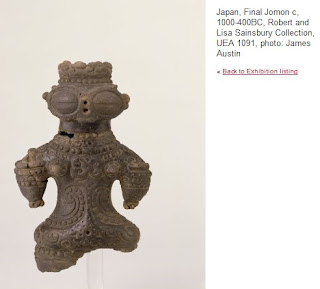
 The figurines are of varying degrees of complexity in both imaginative and technological abilities.
All this is very interesting in various spheres. It might well interest the archaeologist, the historian, the ethnologist, the sociologist, even the technologist and the craftsman. Well and good. But with typical obtuseness the exhibition seeks to point out non-existent links with (gulp) modern Art. So one of the exhibits is this:
 I think it's by the Chapman Brothers (Jake and Dinos) and I think it's called "Dead Guys" - but I'm open to correction here. Anyway, it's supposedly inspired/based on one of Goya's macabre etchings of body parts hanging in a tree.
But what on earth does it have to do with the rest of the exhibition? It's not alone in its inappropriateness - there's a sort of Barbie Doll presented in a glass case, and a 1960s Japanese plastic toy featuring small figures of an Emperor and a concubine. It's part of this loony desire to establish modern Art as the inheritor of a hundred thousand years of human creativity. But these ancient figurines are a mystery. We do not know what they were for, what purpose they were created to fulfil. We do not even know whether all the old artefacts in this exhibition were created for similar purposes. We cannot know this. We do not know how the creators of these artefacts and their societies functioned on a physical level, let alone the intellectual or spiritual context in which they were made.
But we can be sure of one thing: the creation of these ancient figurines was not attended by the cynical money-grubbing of the modern Art World. And the shaping and firing of the simplest of the figurines required a great deal more technological sophistication in the manipulation of materials than that needed for sticking a few bits of Lego together. Or putting a barbie Doll in a plastic case.


All this is very interesting in various spheres. It might well interest the archaeologist, the historian, the ethnologist, the sociologist, even the technologist and the craftsman. Well and good. But with typical obtuseness the exhibition seeks to point out non-existent links with (gulp) modern Art. So one of the exhibits is this:

But what on earth does it have to do with the rest of the exhibition? It's not alone in its inappropriateness - there's a sort of Barbie Doll presented in a glass case, and a 1960s Japanese plastic toy featuring small figures of an Emperor and a concubine. It's part of this loony desire to establish modern Art as the inheritor of a hundred thousand years of human creativity. But these ancient figurines are a mystery. We do not know what they were for, what purpose they were created to fulfil. We do not even know whether all the old artefacts in this exhibition were created for similar purposes. We cannot know this. We do not know how the creators of these artefacts and their societies functioned on a physical level, let alone the intellectual or spiritual context in which they were made.
But we can be sure of one thing: the creation of these ancient figurines was not attended by the cynical money-grubbing of the modern Art World. And the shaping and firing of the simplest of the figurines required a great deal more technological sophistication in the manipulation of materials than that needed for sticking a few bits of Lego together. Or putting a barbie Doll in a plastic case.
Tuesday, May 25, 2010
Possibly the best supper ever
I'm currently reading Frances Spalding's biog of John and Myfanwy Piper ("Lives In Art"), and one of the suppers Myfanwy would rustle up for family and guests during the hard days of WW2,with strict rationing but with her chickens' free range eggs, was simply to fry a couple of 'em and put an anchovy fillet on each egg. It really works, But here's my ultimate version of this - steam four or five shoots of fresh asparagus per person for 12 minutes; fry two good eggs per person; cut a thin slice of good bread per person. Put the eggs on the bread, drape one anchovy slice over each fried egg, arrange the asparagus spears around the bread, and serve with butter and a little salt for those who want it. We had this tonight and it was just heavenly.
French toilet habits
A rant. Why do the French seem to delight in crapping in the bushes and among the picnic tables in their (very nice) Motorway Aires? Nearly all of them have decent loos now (sit-ons as opposed to the old squatters) so why don't they use them? The worst example we found was in the very pleasant small Aire on the road between Dreux and Evreux. OK, so it's not motorway. But the picnic area was covered in small heaps of bogroll and - how shall we put it? - ordure of the human variety. What's wrong with the bloody loos? They're open 24/7; they're free; they're even quite clean. Is it the right of every Frenchman to crap where-ever he likes?
Sunday, May 23, 2010
Oradour sur Glane
In France recently, staying with friends Roy and Michelle, we went to see the town of Oradour, west of Limoges - or what's left of it. 200 SS soldiers killed the 640 inhabitants and burned the town in 1944. And they killed all the inhabitants - right down to babies of a month old. It wasn't some out-of-control unit either - they were acting under orders, and it was carefully planned as a reprisal for resistance activity. A year later De Gaulle visited the site and asked that it be kept in perpetuity as a reminder to the world of the barbarity of the Third Reich.
I took a lot of photos and wept a bit as we walked round. What was somehow more dispiritng was the discovery that some of the SS troops were in fact French, conscripted from Alsace-Lorraine. Anyway, here are a few of the photos.

The trams used to run between Oradour and Limoges. Oradour was a favourite picnic spot for the city dwellers.
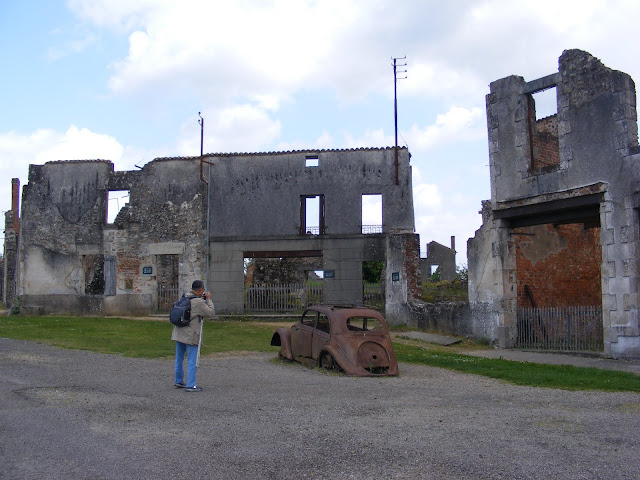
The car (a Renault I think) has been there since 1944, as the Germans left it.


I took a lot of photos and wept a bit as we walked round. What was somehow more dispiritng was the discovery that some of the SS troops were in fact French, conscripted from Alsace-Lorraine. Anyway, here are a few of the photos.

The trams used to run between Oradour and Limoges. Oradour was a favourite picnic spot for the city dwellers.

The car (a Renault I think) has been there since 1944, as the Germans left it.

Below - a few of the names on the village memorial. Note the ages.

I don't know if you're familiar with the idea of the "inner discourse", but there's an article on Wikipedia which gives this as an example of the process: An inner discourse takes place much as would a discussion with a second person. One might think, "I need $27 for the paper boy. I have some paper currency in my wallet. Ten plus ten plus five... I have $25. Damn. Maybe I dropped coins in the sofa. Ah, here they are..." The ideal form of inner discourse would seem to be one that starts with statements about matters of fact and proceeds with logical rigor until a solution is achieved.
What (I kept wondering as we walked round Oradour) was the inner discourse of the killers? What did they tell themselves they were doing as they machine gunned terrified, unarmed men and boys? As they walked over the dead and dying to administer the coup de grace with a luger to those who were still twitching or crying out? What did they tell themselves they were doing as they herded all the women and children - yes, down to infants of one month - into the town church and set fire to it with incendiary devices? As they machine gunned those women and children who tried to escape the conflagration? As they piled up the bodies to burn them, or dug pits hastily for mass burials?
They knew what they were doing - they lied about it immediately afterwards in official documents, and later at the few trials which dribbled on into the 1980s. None of them stayed in prison very long; the French SS were pardoned because they said they were acting under duress.
This was shock and awe on a local scale. How have Bush and Blair escaped prosecution for their city-wide shock and awe in Iraq?
Sunday, April 11, 2010
Election news
Well, Tracey Emin has come out for the Tory Party. That should scupper their chances. Well done, Trace!
 Oh, in case you've forgotten, here's one of her "artworks" complete with used condoms and blood stained pants. Very life enhancing.

Friday, January 29, 2010
Andrew Graham Dixon
Watched The Culture Show on Beeb 2 last night, and finally worked out why I so dislike Andrew Graham Dixon. He's such a Groupie! Seeing him sucking up to Chris Ofili made me want to puke. And I like Chris Ofili, I think he has an interesting talent. But AGD - no thanks.
Sunday, January 24, 2010
A S Byatt - The Children's Book; Lenny Henry on Pollock
I'm currently reading this - about halfway through the 600 odd pages at the moment - and I'm amazed by the relevance of the story to the main obsession of this blog. Loosely based on the lives of several late 19th/early 20th century British artists, writers and connoisseurs (E E Nesbit, Eric Gill, D H Lawrence etc) and their families, A S Byatt has written a gripping tale which highlights the centrality of skill and craftmanship in Art. Very much worth reading.
And then there was a programme on Radio Four this week which featured Lenny Henry trying to come to terms with Jackson Pollock's work, with the help of a couple of critics, including Brian Sewell who concluded that Pollock's dribble paintings would make good designs for linoleum. Let's see:

Hmmm.
And then there was a programme on Radio Four this week which featured Lenny Henry trying to come to terms with Jackson Pollock's work, with the help of a couple of critics, including Brian Sewell who concluded that Pollock's dribble paintings would make good designs for linoleum. Let's see:

Hmmm.
Subscribe to:
Posts (Atom)